
1
Everything is going according to the plan of the “foreign sentinel.”(1) One could almost add that the current scenario resembles that of the late twentieth century, when Venezuelan society decided that the best option was change by peaceful and democratic means. But this is no time to make concessions to the past. As the President of the Venezuelan Episcopal Conference declared: “We must all acknowledge, with humility, that we arrived at January 3 because, as a society, although we tried by every means within our reach… we did not find a common course of action,” and “for that reason an external agent had to intervene.”(2) We tried, but we were not capable of it. The moment demands more of us than a gesture of contrition. It is time to turn the page.
One must also recognize, as Monsignor Jesús González de Zárate might have said, that the “external agent” does not want another Iraq. Thank God. Indeed, this is what the State Department says: “we would prefer not to have bloodshed and not have instability and not have civil war in a place. We would prefer the peaceful transition process, which is why we are required to, as a result, work with the interim authorities to make all of these reforms and to use the leverage we have to ensure that these reforms continue to move forward on a proper pace.” The “leverage” is such that, in reality, the “collaboration” is mutual. Even so, there is impatience, dissatisfaction, perhaps even incomprehension: the transition is moving very slowly. There is a desire for revenge.
In response, the State Department adopts a condescending tone: it acknowledges that the issue of political reforms “really hasn’t gotten nearly as much attention as some of the other more higher-profile things on the economic side, the oil deals and et cetera,” but asks us to understand that the political must be kept in step with the economic. There could be elections in the very short term, because it must be admitted that “they know how to run” them, but the current institutions might refuse to recognize the results. It says it is on the way to resolving this matter, but explains that there is another one that is much more important and therefore a priority: “if you want a democratically elected government to succeed, you don’t want them to inherit an economic apocalypse that brings it down. Because you’ll have an election, everybody will be happy, but a month later everyone’s gonna be mad that there’s fuel shortages, that there’s no electricity.” It insists: “if you want a democratically elected government to succeed, … you can’t leave them saddled with an economic calamity, because eventually no matter how happy people are, they had an election, they still want to eat. They still want to be able to pay their bills, and they still want the electrical power to not … suffer from chronic blackouts.”
2
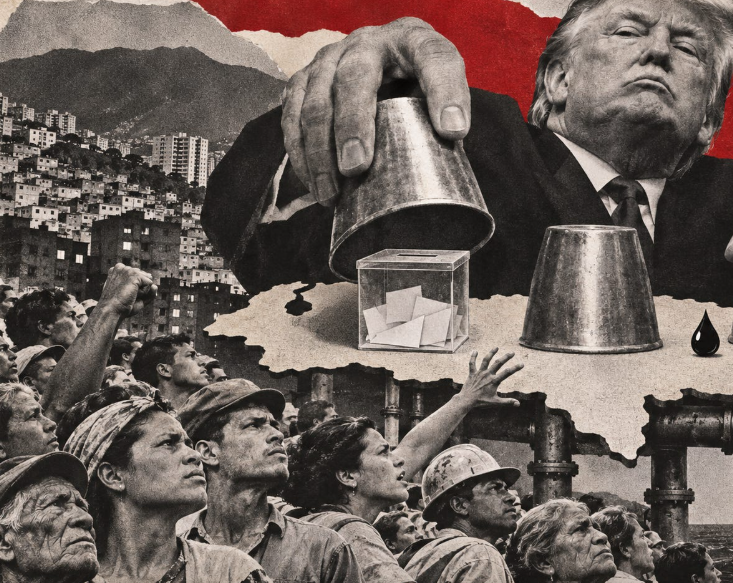
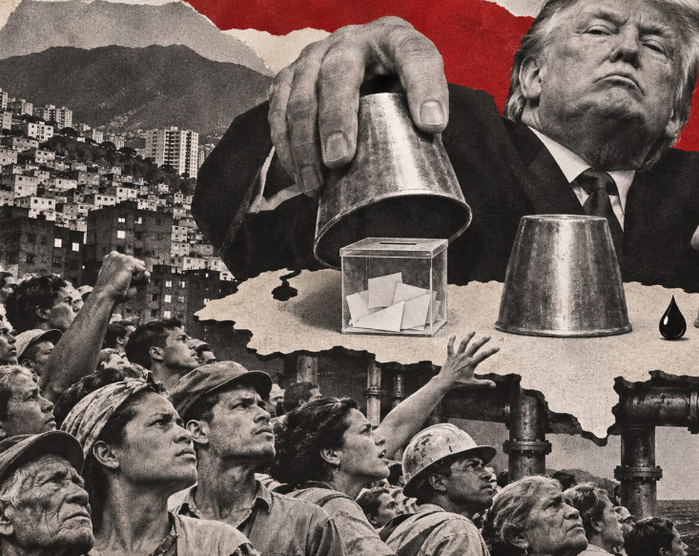
Ever since, we have witnessed a curious spectacle: an army of analysts racking their brains, trying to decipher the mystery hidden behind those words, some clue that might let them guess when presidential elections will be held. It is like walking down the street and coming upon a small crowd gathered around one of those loudmouthed, quick-fingered characters running the shell game. Something similar happens every time some imperial spokesman decides to try out the phrase: “All options are on the table.” There will always be someone who bets and loses.
The answer is very simple and there is no such thing as a mystery: there will be elections when the USAmerican government decides so. The bettor will never find the pea, skillfully hidden in the hands of the one moving the shells. Whoever accepts that someone else decides what all the options are has lost in advance.
Everything unfolds according to the rules of street magic: the “external agent” acts as if it had nothing to do with the “economic apocalypse,” with the fuel shortages, with the power cuts, with people’s difficulty in putting food on the table and paying their bills, and tells us it is working to create the conditions that will allow us to hold free and fair elections. It also acts to favor, electorally, political figures who, for their part, behave as if they were angels who have never in their lives broken any of the first four seals. As a finishing touch, it offers us the “chance” of an “enduring republic” when in reality it intends to deny us the option of existing as a true republic.
It may be true that the USA does not want another Iraq in Venezuela. And the real reasons for this can be debated. But what matters here is that, when it comes to defining its goal, the State Department has no qualms about trying out its crude and clumsy version of the Kingdom of God on Earth. But when it comes to talking about options on the table, try as it might, it cannot help showing itself as it is: a “foreign sentinel” acting as a regressive force. There are only two options: “peaceful transition” or “civil war.” One way or another the goal will be achieved: the “democratic transition.” Make no mistake: the USA would prefer “not to have bloodshed and not have instability and not have civil war.” But things have to be done its way. “I am democracy,” the State Department tells us, in the finest tradition of nineteenth-century Bonapartism.
If things can only be done the USAmerican way, it is because the possibility of doing them the Venezuelan way has been denied in advance. That denial is, in itself, an act of violence. It is the continuation of a war that began without a formal declaration. A “peaceful transition” is under way, we are told, but the Constitution that we ratified by popular vote is systematically violated, whether de facto or through legislative acts of regressive content enacted at the request of the “foreign sentinel.” This is violence with dramatic material effects. One need only look at any of the fundamental problems of Venezuelan society: the value of its labor power, the state of its public services, the exploitation of its natural resources, and so on. Any decision relating to any of these matters is taken to safeguard the interests of the USAmerican government, of its businessmen and, of course, of the local businessmen aligned with this exercise in continued plunder.
It is not that things cannot be done the Venezuelan way, that is, by putting the interests of the nation first, simply because we tried and did not find a path, so that we must now accept external intervention as a fatality, given our errors and omissions, as the Episcopal Conference has put it. In reality, the USAmerican government has not come to resolve the situation. The “economic calamity” was, is and will be: it was the result, partial but decisive, of its meddling; it is a precondition for the intervention under way; and it will be the consequence of the continued plunder of our wealth, of its control over our economy in particular and our institutions in general, that is, of our loss of sovereignty.
Venezuelan reality gives the lie to any kinship with the rhetoric of the State Department, which is rather the stuff of utopian millenarianism, and is akin to dystopia, and that in the best of cases. For it can only be dystopian, if not simply cynical, a rhetoric that promises “democratic transition” to a society that should consequently be celebrating the imminent advent of freedom, when the stubborn facts speak to us of continuity and deepening of the catastrophe, but with our own faces, once elections are held. “O, what a goodly outside falsehood hath!” [Shakespeare, The Merchant of Venice]
3
And how deceptive popular victories can seem when they are in the mouths of those who traffic in historical truth.
The State Department’s rhetoric, with its references to the present “economic apocalypse,” would be the vanguard of the form taken by the narrative that, broadly speaking, the Venezuelan right has built about the Bolivarian Revolution: that of an eschatology of the past. The apocalypse has already happened, and the survivors of the horror bear witness to it today.
Building a solid and genuine popular option that allows us to recover our condition as a free, sovereign and independent nation requires putting this eschatological interpretation of our recent history in its place. Under the leadership of Hugo Chávez, the Bolivarian Revolution could have been many things: a timid reformist attempt, a promising democratic experiment razed with blood and fire by the oligarchy, a process drowned under the weight of its own contradictions. On the contrary, it was a successful experience, with more than tangible results, with its corresponding lights and shadows.
Thus, for example, between 2003 and 2012 the percentage of Venezuelan households in poverty fell from 54% to 21.2%, while the percentage of households in extreme poverty dropped from 25.1% to 6%. By 2012, the number of undernourished people estimated for 1990 had been cut by half or more. Between 1978 and 1999, annual growth in gross domestic product per capita turned negative, at a rate close to -2%. By contrast, GDP per capita rose 58.1% between 2003 and 2012. In 2012, the integral minimum wage was around $644, and the country recorded the highest Real Minimum Wage Index in Latin America. Also in 2012, Venezuela was the second least unequal country in the region (Gini index). That same year, Chávez approved an Organic Labor Law that restored the retroactivity of social benefits, reduced the daytime working day to 40 hours a week (8 hours a day) and expressly prohibited the outsourcing or subcontracting of permanent activities.(3) What horror!
At the antipodes of apocalypse or calamity, the time of the Bolivarian Revolution under Chávez’s leadership meant, for the popular majorities, the temporary interruption of the catastrophe.(5) And it was so, in large measure, because it had the historic good judgment to confront the trilemma: “what to produce, how to produce and for whom to produce,” which Domingo Alberto Rangel defined as the “unshakable foundations of an economic order.”(6) Ospina himself pointed out “how arrogant and insensitive oil elites strolled around the world like Saudi sheikhs while the Venezuelan people sank into poverty and abandonment. No one can deny that those elites were the ones who educated the country in the precarious logic of subsidies and who never made serious efforts to ‘sow the oil,’ to convert oil wealth into a diverse economy that would stimulate social labor and community initiative. Later they would reproach Chávez for not having fully accomplished in ten years the sowing and diversification that they did not attempt in 50.” Nowadays, with a levity worthy of better purposes, it is common to hear voices from across the political spectrum making exactly the same reproach.
Appealing to the need to grasp the sign of the times, perhaps in an attempt to avoid the difficult plight of being singled out as political species on the road to extinction, there are those who argue that going back over the history of the Bolivarian Revolution amounts to living in the past. Walter Benjamin already warned us of the dangers of swimming with the current.(7) To brush history against the grain means today to muster the strength of spirit needed to undertake an indispensable task: to narrate the trajectory of a revolutionary experience that knew how to be the interruption of the catastrophe and, perhaps more important still, to give an account of its own interruption, for which, incidentally, responsibility cannot fall on Hugo Chávez.
The interruption of the progressive trajectory of the Bolivarian experience was accepted by the popular majorities as a fait accompli a decade ago. Denying the evidence is self-defeating, because it amounts to continuing to spend what one no longer has: an enormous political energy. The same happened with time: in trying to gain it, a precious historic opportunity was squandered. Today the situation is very different and the accumulated debt is enormous.
There will soon be elections in Venezuela, and there will be those who celebrate in the streets, thus consummating a transition that will really be continuity. They will go on talking about democracy to a country that has had its freedom snatched away, and once again popular rage will be expressed. The majorities will fight to reverse the situation, that is, to put things in their place. Then they will celebrate, this time for real, massively and noisily, and they will raise a toast to the health of those who in their day knew how to recognize themselves in “the deep wisdom, the cunning, the mischief and the courage of the popular soul.” It is a matter of time. There is no sleight of hand. This is a people that has never stopped fighting. Whether it happens sooner or later will depend, in large measure, on the will to settle accounts with our own history.
References
(1) Antonio Gramsci. Notas sobre Maquiavelo, sobre la política y sobre el Estado moderno [Notes on Machiavelli, on Politics, and on the Modern State]. Nueva Visión, Buenos Aires, 1972, p. 61. [English]
(2) Leopoldo Puchi. El «tuvo que» de la CEV [The “Had To” of the Venezuelan Episcopal Conference]. El Universal, October 25, 2026.
(3) Poverty and extreme poverty: Instituto Nacional de Estadística. Undernourishment: FAO. GDP per capita: Alí Rodríguez Araque and Bernard Mommer. “Primer centenario de la Venezuela exportadora de petróleo” [First Centenary of Oil-Exporting Venezuela]. Aporrea, November 28, 2017. Also: Malfred Gerig. La Larga Depresión venezolana. Economía política del auge y caída del siglo petrolero [The Long Venezuelan Depression. Political Economy of the Rise and Fall of the Oil Century]. Centro de Estudios para la Democracia Socialista, Trinchera. Caracas, Venezuela, 2022, pp. 70-71. Integral minimum wage: Reinaldo Iturriza López. El chavismo en el laberinto hegemónico (y una novedad histórica) [Chavismo in the Hegemonic Labyrinth (and a Historical Novelty)]. Saber y Poder, December 16, 2021. Real Minimum Wage Index: ECLAC (Economic Commission for Latin America and the Caribbean; CEPAL in Spanish). Gini index: ECLAC. Social benefits, working hours, subcontracting: Ley Orgánica del Trabajo, los Trabajadores y las Trabajadoras [Organic Law on Labor, Male Workers and Female Workers].
(4) William Ospina. Chávez: una revolución democrática [Chávez: A Democratic Revolution]. El Espectador, March 9, 2013.
(5) Reinaldo Iturriza López. Hipótesis sobre nuestro tiempo del ahora [Hypotheses on Our Time of the Now]. Saber y Poder, October 19, 2026.
(6) Domingo Alberto Rangel. Capital y desarrollo. Tomo I: La Venezuela agraria [Capital and Development. Volume I: Agrarian Venezuela]. Universidad Central de Venezuela. Instituto de Investigaciones Económicas y Sociales. Caracas, Venezuela, 1969, p. 14.
(7) Walter Benjamin. Tesis sobre la historia y otros fragmentos. Universidad Autónoma de la Ciudad de México. Editorial Ítaca. Mexico, 2008, p. 46. [Theses on the Philosophy of History]
English version published in Tlaxcala
Translated by Fausto Giudice